


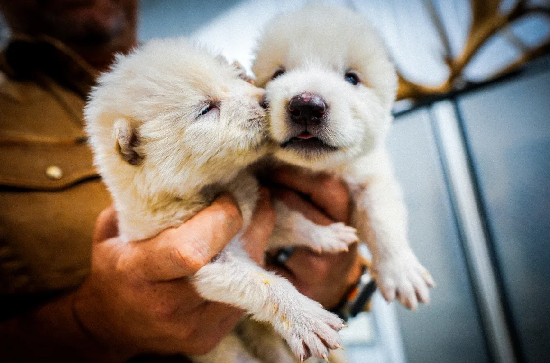
The fearsome dire wolf, a prehistoric predator that vanished around 12,500 years ago and inspired the iconic canines of "Game of Thrones," has reportedly been brought back from extinction. Dallas-based biotech company Colossal Biosciences announced Monday that they have successfully created three dire wolf pups, hailing them as the "world's first successfully de-extincted animal."
Colossal's groundbreaking achievement utilized ancient DNA, cloning, and sophisticated gene-editing technology. By meticulously altering the genes of the gray wolf, the dire wolf's closest living relative, scientists essentially engineered a hybrid species remarkably similar in appearance to its extinct ancestor, Aenocyon dirus.
While Colossal has been vocal about its ambitious projects to resurrect the woolly mammoth, dodo, and Tasmanian tiger since 2021, their work on the dire wolf remained under wraps until this announcement.
"This massive milestone is the first of many coming examples demonstrating that our end-to-end de-extinction technology stack works," declared Ben Lamm, Colossal's cofounder and CEO. "Our team took DNA from a 13,000-year-old tooth and a 72,000-year-old skull and made healthy dire wolf puppies."
The three resurrected dire wolves currently reside in a secure 2,000-acre facility at an undisclosed location. Protected by 10-foot "zoo-grade" fencing, the animals are continuously monitored by security personnel, drones, and live camera feeds. Colossal emphasized the facility's certification by the American Humane Society and registration with the US Department of Agriculture.
Decoding Ancient DNA: The Blueprint for Resurrection
Colossal's scientific team and collaborators painstakingly pieced together two high-quality Aenocyon dirus genomes – complete sets of genetic information – using ancient DNA extracted from two separate dire wolf fossils.
By comparing these ancient genomes with those of extant canids like wolves, jackals, and foxes, the researchers identified the specific genetic variations responsible for the dire wolf's unique traits, such as its potentially lighter, thicker fur and stronger jaw compared to gray wolves.
Armed with this genetic blueprint, Colossal employed CRISPR technology to precisely edit gray wolf cells. They made 20 alterations across 14 genes, ultimately cloning the most promising cell lines and implanting them into donor eggs.
In a remarkable feat of interspecies gestation, healthy developing embryos were transferred into surrogate mothers – Colossal confirmed to CNN that these surrogates were large, mixed-breed domestic dogs. This resulted in three successful pregnancies and the births of the first de-extinct species.
Two male dire wolf pups were born on October 1, 2024, followed by a female pup on January 30, 2025.
A Hybrid Reality: Gene Editing and the Definition of "De-Extinction"
Love Dalén, an evolutionary genomics professor at Stockholm University and an advisor to Colossal, explained that the company essentially created a hybrid genome. CRISPR technology was used to "cut away" certain gray wolf gene variants and replace them with the genetic markers associated with dire wolf characteristics.
"There’s no secret that across the genome, this is 99.9% gray wolf. There is going to be an argument in the scientific community regarding how many genes need to be changed to make a dire wolf, but this is really a philosophical question," Dalén noted.
However, he emphasized the significance of the achievement: "It carries dire wolf genes, and these genes make it look more like a dire wolf than anything we’ve seen in the last 13,000 years. And that is very cool."
Dalén, who had some involvement in the dire wolf genome analysis but was not part of the gene editing or cloning process, hailed the work as a "huge leap" in the field. He believes that Colossal has effectively resurrected the dire wolf phenotype – its observable traits – aligning with what the genome suggests these animals likely looked like. "To me, it’s a dire wolf in that sense," he concluded.
Beyond the Dire Wolf: Implications for Conservation
Since its founding in 2021 by entrepreneur Ben Lamm and Harvard geneticist George Church, Colossal has raised significant funding, at least $435 million, initially focusing on the woolly mammoth. While the mammoth project is slated to produce its first calves in 2028, the rapid success with the dire wolf highlights the potential of their technology.
Interestingly, Colossal hopes that the very technologies used to resurrect the dire wolf can be directly applied to aid endangered species. The company announced that it has already produced two litters of cloned red wolves, a critically endangered species, using a novel, less invasive cloning method developed during the dire wolf research.
Ethical Considerations and the Future Role of De-Extinct Animals
While the scientific achievement is remarkable, the concept of de-extinction faces ethical scrutiny. Critics often question the allocation of vast sums of money that could potentially be used for existing conservation efforts. Concerns also arise regarding the welfare of surrogate animals and the potential ecological impact of introducing hybrid creatures.
Christopher Preston, an environmental philosophy professor at the University of Montana, acknowledged Colossal's apparent attention to animal welfare, citing the size of the facility and the American Humane Society's involvement. He also noted the company's precautions against unintended genetic consequences.
However, Preston raised a crucial question about the ecological role of these resurrected animals, particularly in contrast to Colossal's stated goal for genetically engineered mammoths. "It is hard to imagine dire wolves ever being released and taking up an ecological role. So, I think it is important to ask what role the new animals will serve," he concluded, highlighting the ongoing challenges in even maintaining healthy gray wolf populations in the face of political opposition.
Despite these questions, the resurrection of the dire wolf marks a significant milestone in the field of de-extinction, raising profound scientific and ethical considerations about the future of life on Earth.