


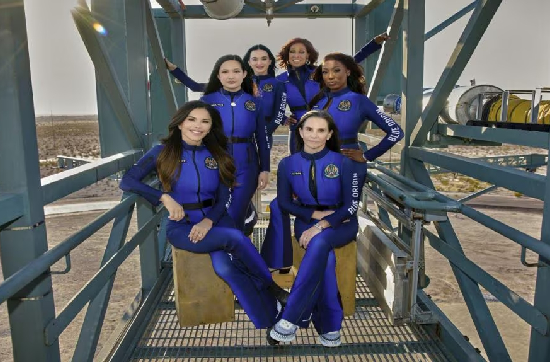
Pop sensation Katy Perry recently shared visuals of her post-spaceflight Earth embrace, following a brief but exhilarating journey aboard Blue Origin, Jeff Bezos' space venture. Her enthusiastic "10 out of 10, definitely go for it!" review has reignited the public's curiosity about space tourism and its accessibility.
Perry was part of Blue Origin's latest all-female mission, which also included Bezos' fiancée Lauren Sanchez, media titan Gayle King, human rights advocate Amanda Nguyen, film producer Kerianne Flynn, and former NASA rocket scientist Aisha Bowe. Their 11-minute suborbital flight has left many wondering when their own celestial adventure might begin.
Blue Origin's All-Women Blast-Off:
On Monday, April 14th, Blue Origin's New Shepard rocket propelled six women beyond the internationally recognized Kármán line (100 km above Earth). This brief foray offered precious minutes of weightlessness before their safe return just eleven minutes later. The passengers, including Katy Perry and Gayle King, were visibly moved by the experience. King described the Kármán line as "oddly quiet" and "peaceful," reflecting on the profound perspective gained by looking down at our planet.
The Burgeoning Space Tourism Industry:
This successful mission marks Blue Origin's 52nd individual sent past Earth's atmospheric edge. Notable past passengers include Jeff Bezos himself on the inaugural crewed flight in 2021 and "Star Trek" icon William Shatner, who became the oldest person in space at 90 in 2022. Elon Musk's SpaceX has also previously launched private citizens, including celebrities and billionaires, further highlighting the growing interest in making space travel a reality for non-astronauts.
The concept of space tourism isn't new. NASA predicted its multi-billion dollar potential as early as 1997, a sentiment echoed by a Japanese report forecasting a $10 billion annual industry within two decades. The industry encompasses two main categories: sub-orbital flights, offering a brief experience beyond the Kármán line, and orbital tourism, venturing much further into space.
Currently, the primary players in this emerging market are Blue Origin, Richard Branson's Virgin Galactic, and Elon Musk's SpaceX. While Virgin Galactic has flown 37 people (including 23 paying customers on seven commercial flights since 2004), Blue Origin has achieved more frequent success with 11 sub-orbital launches carrying 52 individuals.
The Price Tag of Stardom (and Space):
For most, a trip to orbit remains a distant dream, likely requiring either immense wealth or significant public profile to warrant an invitation. While Blue Origin doesn't publicly disclose the cost of their flights, their website mentions a $150,000 (approximately ₹1.28 crore) refundable deposit for applicants. However, past instances, like a 2021 auction for a maiden flight seat, saw bids reach a staggering $28 million (approximately ₹241 crore). Some passengers have reportedly paid anywhere from nothing to nearly $30 million (approximately ₹258 crore) for a seat.
Blue Origin spokesperson Bill Kircos indicated that some passengers on the recent all-female flight flew "free of charge," while others paid, without specifying who fell into which category. Roman Chiporukha, co-founder of SpaceVIP, a platform catering to wealthy individuals seeking space travel, including Blue Origin flights, suggests that selection isn't solely about finances. "It’s not about money; it’s about who you are, your social capital, whether you align with their launch purposes. It’s kind of a package deal," he told The Observer.
While Blue Origin keeps its pricing private, Virgin Galactic has marketed 90-minute suborbital rides at $450,000 (approximately ₹3.85 crore) per seat. Space Perspective offers a more leisurely six-hour stratospheric balloon journey for $125,000 (approximately ₹1.07 crore) per person in a pressurized capsule. For a more extended experience, Texas-based startup Axiom Space has been offering 10-day trips to the International Space Station for a hefty $55 million.
Experts predict that the cost of space travel will decrease as more companies enter the arena and launch frequency increases. Koji Yamanaka, director of Japan’s space exploration centre, envisions a future where "common people will go to the Moon as tourists," although the timeline for this remains uncertain.
The Future of Cosmic Getaways:
Despite currently being a luxury for the elite, space tourism is projected to become more accessible in the near future. The industry, valued at $848.28 million in 2023, has already grown to $1.3 billion in 2024. Research and Markets estimates the global space tourism market will reach $6.7 billion by 2030, representing a significant 31.6% growth rate.
However, the dream of routine space travel for the average person still requires patience. For now, we may have to live vicariously through the experiences of celebrities and astronauts who are currently breaking through the final frontier.